


Estimated Read Time 6 Minutes
0%

Editor's Pick

Our #1 Pick for Kidney Support:
ClarityMD Astaxanthin 12mg
by ClarityMD

SPONSORED ADVERTISING CONTENT
I Put 5 Kidney Support Supplements Through 4 Checks. Only One Passed Them All
Search kidney support and you drown in cleanse teas, flush kits, and herbal pills. I dug into one antioxidant for months, one with peer-reviewed studies on its side, sorting the real doses from the overpriced bottles of hype.
Advertiser Disclosure
Advertiser Disclosure:
This page is a paid advertisement published by ClarityMD, the company that makes the product ranked number one.
When you buy through the links on this page, you buy from ClarityMD. The other four products are sold by companies that did not take part in this review. Their prices and label details come from each brand's own website and can change.
Go back to page
The 3 Label Shortcuts That Make Most Kidney Supplements a Waste of Money
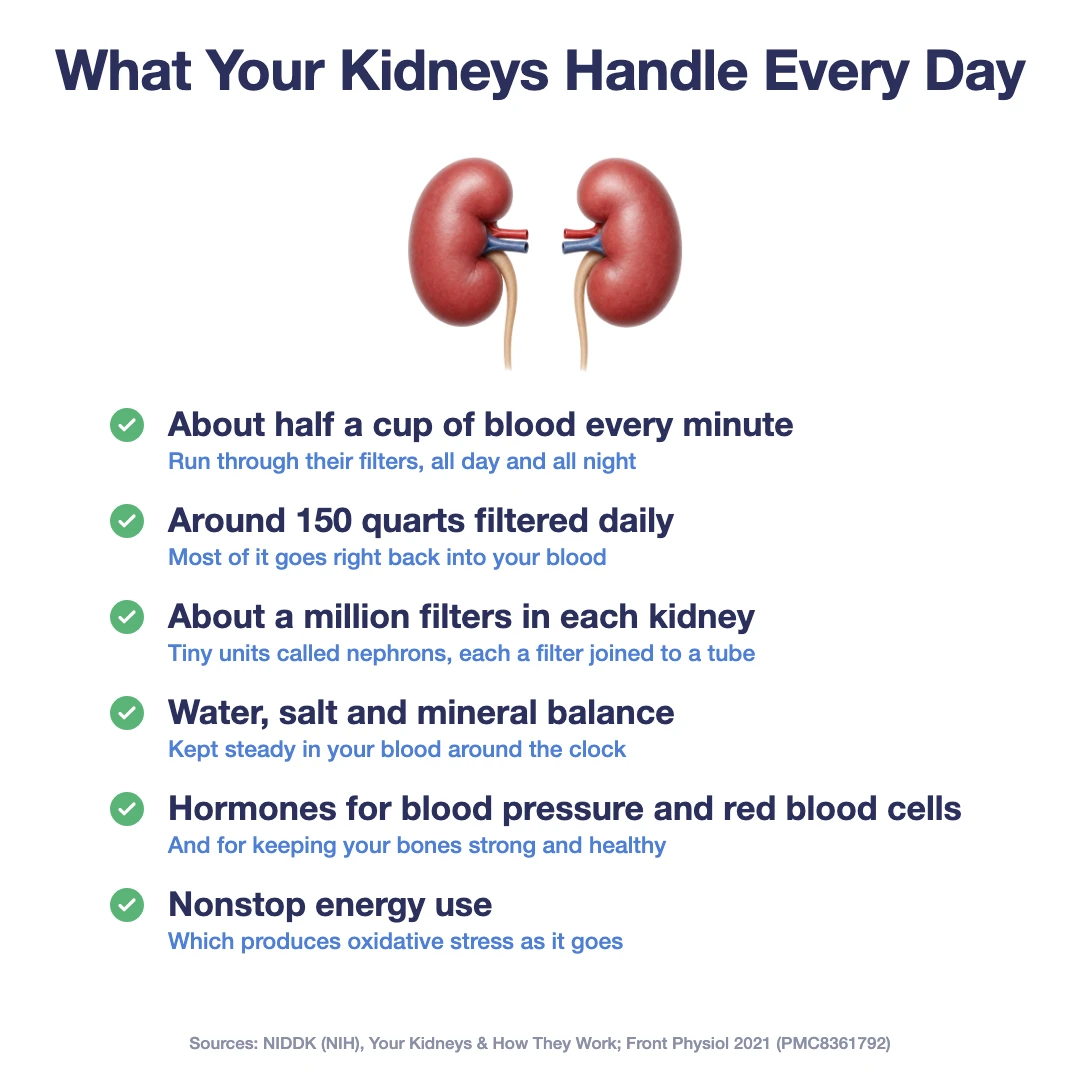
The antioxidant I dug into is astaxanthin. More than 80 human studies have tested it, and oxidative stress was among the things they measured. That's the strain your kidneys take on filtering roughly 150 quarts of blood each day.
So maybe you bought a bottle, finished it, and couldn't name one thing that felt different.
I held the labels up to the studies and found the reason. Plenty of bottles take at least one of three shortcuts: a low dose, a synthetic source, or a dry powder capsule.
Many cheaper bottles hold 4mg or 6mg. That's a third to half of 12mg, a dose on the higher side of what human studies tested. Most of that research used the natural form, grown in microalgae. And astaxanthin absorbs better with fat, which a dry capsule doesn't carry.
The problem: most kidney supplements cut corners you only spot once you turn the bottle around and read the fine print.
Some are herbal blends. This is how each one shows up on a real label:
❌Dose: 4mg or 6mg a softgel, short of a full 12mg
❌Source: Just "astaxanthin" on the label, with no word on algae or synthetic
❌Delivery: A dry powder capsule for an ingredient that dissolves in fat
The Fat Factor: Why Astaxanthin Without Oil Is a Gamble
Astaxanthin is the red pigment behind the color of salmon and shrimp. The richest natural source is a freshwater microalga called Haematococcus pluvialis.
The catch: it dissolves in fat. Your body takes it in along with the fat in your meal, so with little fat around, less of it gets in.
A small Japanese study gave people algae astaxanthin before or after a meal. The after-meal group reached about 2.4 times the blood levels.
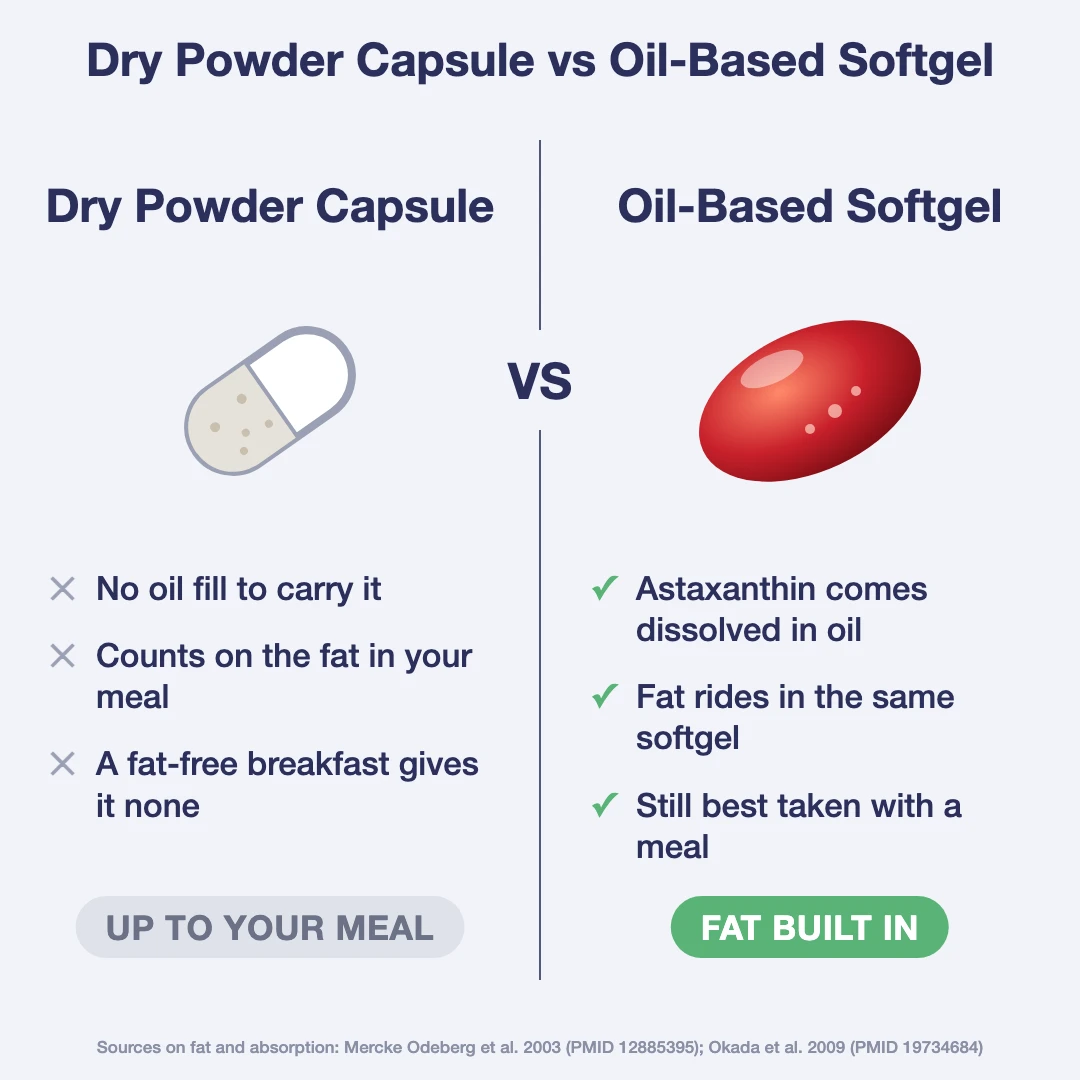
That's why the format on the label matters. An oil-filled softgel brings its own fat to a fat-soluble ingredient. A dry powder capsule leaves it all to your meal, and a black coffee breakfast gives it nothing to work with.
Then there's the source. The human research on astaxanthin was done mostly with the natural, algae-grown form. Synthetic astaxanthin comes out of a chemical plant, and most of it goes into fish feed to color farmed salmon.
So once the dose checks out, I look at the label for two more things: natural microalgae, in an oil-based softgel.
What Can a Real-Dose Astaxanthin Supplement Actually Do?
I'll keep this honest. Astaxanthin is an antioxidant, and its job is helping your body handle oxidative stress.
This is what I'd expect from a real-dose astaxanthin supplement:
Antioxidant Support:
✅ Helps your body handle everyday oxidative stress
✅ May help neutralize free radicals
✅ Tested against a placebo in 12 human trials on oxidative stress
Built for Every Day:
✅ Antioxidant support you take daily, with a meal
✅ Stays in your blood for hours: about a 16-hour half-life in one study
A Clean Record in Human Studies:
✅ No safety concerns in any of 87 human studies of the natural form
The Kidney Connection: What Nonstop Filtering Leaves Behind
Two fist-sized organs handle a workload most people never think about, and that kind of work never comes free.
The Daily Wear Your Kidneys Take (And Why It Adds Up)
Inside each kidney sit about a million tiny filters called nephrons. The filtering never stops for sleep or weekends.
Keeping that up takes a lot of fuel. Nearly a quarter of your heart's output flows through them, and gram for gram, they burn through more oxygen than any organ but the heart.
All that energy use has a price: oxidative stress. Your cells make it as they burn fuel, and your body leans on antioxidants to handle it.
That's the reason I went looking at antioxidants in the first place, and why I wasn't willing to pay for one that cut corners.
The Solution: 12mg, Natural Algae, and an Oil-Based Softgel
Take those three shortcuts from earlier and flip them around. An astaxanthin supplement worth your money gets all three right:
✅ A full 12mg a day: on the higher side of what human studies have tested
✅ Natural microalgae source: Haematococcus pluvialis, named right on the label
✅ Oil-based softgel: the oil is already in there
One caution: skip it if you have a shellfish allergy, and if you take a blood thinner, are pregnant or nursing, are under 18, or are under a doctor's care, show your doctor the label first.
The bottom line: if you're adding an antioxidant for the long haul, check the dose, source, and delivery before you buy. Miss one and you're paying full price for less.
The 3-Part Label Test That Separates Good Astaxanthin From Bad
Before any bottle got a grade, its label had to answer these three questions:
A good chunk of the human astaxanthin trials gave people at least 12mg daily. Plenty went lower, which makes 12mg a generous amount. Budget brands often trim the dose to 4mg or 6mg so the bottle costs less to make. That leaves you a third to half as much per serving, in a bottle that looks just as good on the shelf. Want a dose bigger than most trials used? Hold out for 12mg.
The Rule: Check the serving size first. When a 12mg label needs four softgels, you're getting a mere 3mg in each.
Astaxanthin gets made two ways. The natural one is made by an alga, Haematococcus pluvialis. The synthetic one is put together from petrochemicals in a chemical plant. Most of the human trials used the natural, algae kind. So I want the label to say natural or name the microalgae. If all it says is astaxanthin, you're left guessing which one you bought.
The Rule: Scan the Supplement Facts panel for Haematococcus pluvialis. That name means an alga made it, so you're getting the natural kind.
Astaxanthin is a fat-loving compound, so it absorbs best when fat rides along. An oil-packed softgel, most often coconut or MCT, carries that fat into every dose. A dry capsule or powder shows up empty-handed and counts on whatever fat happens to be on your plate. So I scored the format right alongside the milligrams.
The Rule: Tie it to one meal you never skip, and make it one with a little fat in it, like eggs, yogurt or avocado.
WARNING: 5 Kidney Supplement Claims That DON'T Hold Up
You'll see pitches like these on kidney and astaxanthin labels. I checked each one against the research and the label math. This is what the label leaves out:
Claim: "Cleanses your kidneys"
Reality: The National Kidney Foundation's advice on any tea or pill labeled kidney detox or kidney cleanse is to skip it. It calls the evidence behind them limited, and herbs common in them, like uva ursi, horsetail and goldenrod, sit on its caution list.
Claim: "Exclusive kidney support complex"
Reality: When a label rolls its ingredients into one blend, you can't see the amount of each one inside, so you can't know your dose. The National Kidney Foundation tells people to steer clear of them.
Claim: "Same astaxanthin, lower price"
Reality: The synthetic version is a different mix of molecule shapes than the algae kind. So when a cheap label won't say where its astaxanthin comes from, you can't tell which kind you're paying for.
Claim: "Full-strength astaxanthin"
Reality: At 4mg, one softgel holds a third of a 12mg dose. It takes three of them to equal one 12mg softgel, and at least one 4mg label caps you at two a day, which is 8mg.
Claim: "Fast-absorbing formula"
Reality: Astaxanthin dissolves in fat. A dry powder capsule brings no oil of its own, so how much you absorb depends on what you ate with it. Nothing on the label tells you that.
Your 2026 Kidney Support Supplement Buying Checklist
Before you buy any astaxanthin, check the bottle for these 6 things:
Look for: 12mg of astaxanthin on the Supplement Facts panel, with a serving size of one softgel.
Why it matters: In a 2019 safety review, 35 of the 87 human studies gave people 12mg or more each day. So 12mg is one of the higher doses that have been tested. One softgel means one pill a day to remember.
Look for: natural astaxanthin from Haematococcus pluvialis microalgae, named right on the panel.
Why it matters: It's the form behind most of the human research. If a label won't name its source, keep shopping.
Look for: a softgel with an oil on the ingredient list, like MCT, coconut or olive oil.
Why it matters: Astaxanthin dissolves in fat and absorbs poorly on its own. The oil inside gives it something to dissolve in.
Look for: a report from an outside lab, posted where you can open it, or a seal from NSF, USP or ConsumerLab.
Why it matters: A lab report you can open is how you know the 12mg on the label is actually in the softgel.
Look for: the astaxanthin, an oil and the softgel shell. No fillers, no proprietary blend, and free-from lines for gluten, dairy and GMOs.
Why it matters: The National Kidney Foundation points people to products with only the one ingredient they mean to take, after checking with their doctor that it's right for them. Read the allergy line too: some astaxanthin softgels carry a shellfish warning.
Look for: at least 90 days and a full refund. Bonus points if you don't have to send anything back.
Why it matters: You want enough time to judge it for yourself, and 90 days is three full months. Some brands give you 30 or 45 days and make you pay to ship it back.
My 2026 Astaxanthin Grades, A+ to C
I held five popular brands to one four-point standard, the same one I'd use before spending my own money on a softgel: dose, source, delivery, and value.
How I scored them:
✅ Dose: the daily amount of astaxanthin, and how many softgels you swallow to get it
✅ Source: natural microalgae, with the label spelling out where it comes from
✅ Delivery: oil inside the softgel, because astaxanthin is fat-soluble
✅ Value: the price, and what the refund policy covers if it doesn't suit you

A+
OVERALL GRADE
PROS
-

12mg per softgel: the full natural dose I was hunting for
-
Pure Hawaiian algae source: the natural form, made by microalgae, with zero petrochemicals
-
Oil-filled softgel: a single daily dose, already in oil to help absorption
-
Independent lab testing: a lab outside the company checks purity and potency, and there's no filler or additive
-
Clean ingredient list: nothing artificial, and it's free of GMOs, gluten and dairy
-
Produced in the USA: every batch runs through a CGMP-certified facility
-
90-day money-back guarantee: if you're unhappy, you get a full refund and don't have to return anything
-
Widely used: 142,000+ customers, by the brand's count
-
Deep discount: $29.99 per bag on subscription, up to 70% off a first order, bundles ship free
CONS
-

First-order pricing and the full 90-day guarantee apply only to orders on ClarityMD's own site
-
$29.99 comes with monthly auto-ship (cancel whenever you want)
The Bottom Line
ClarityMD is the one I'd reorder tomorrow, with zero trade-offs. Shopping with your kidneys in mind? It passed every check on my list, start to finish.
Each oil-based softgel carries a full 12mg of natural astaxanthin, harvested from pure Hawaiian microalgae. Some budget brands get by on the synthetic kind, a lab version cooked up from petrochemicals.
What clinched it was how little they hide. It's third-party tested, so purity and potency get checked by a lab the brand doesn't run. It's made on US soil in a CGMP-certified plant, and the label is free of fillers and additives.
And I'm far from the only one buying it: the brand reports more than 142,000 customers. Each pouch holds 30, you take one daily, and the guarantee gives you 90 days.
Cheaper bottles save money three ways: fewer milligrams, a synthetic stand-in, a dry capsule. ClarityMD holds the line on all three, and its 12mg sits at the high end of the research.
On subscription, $29.99 buys a month of 12mg softgels, sourced from pure Hawaiian microalgae and packed in oil so your body can soak them up. First orders run up to 70% off, and bundles ship free.
Nothing in it is a filler or an additive, so you aren't paying for padding. Plus, ClarityMD's 90-day money-back guarantee hands you a full refund if you're not happy. That's a long, fair runway for making your own call.
Best For:
✅ Anyone who wants to reach 12mg without swallowing four softgels a day
✅ First-time buyers who want 90 days to judge it, with nothing to mail back
✅ People already backing their kidneys with good food and exercise who'd like a daily antioxidant in the mix
Five Tested, One Kidney Support Pick: ClarityMD Astaxanthin 12mg
I lined up five popular astaxanthin supplements and picked each one apart. Only one brand earned a spot in my own cabinet for kidney support:
✅ 12mg in every softgel (the high end of what human trials have tested)
✅ Grown from pure Hawaiian microalgae (the natural form researchers study)
✅ One oil-filled softgel a day (astaxanthin is fat-soluble, so oil helps)
✅ Outside lab tested (the lab report is yours to read)
✅ Clean, short label (GMO, gluten and dairy free, no filler)
✅ 90-day money-back guarantee (a whole season to decide)
✅ Steep first-order savings (up to 70% off, $29.99 per bag for subscribers)
That cabinet spot? ClarityMD.
Some astaxanthin brands look like they were dreamed up in a pricing meeting. ClarityMD looks like someone asked a better question first: will your body take this in?
Results come from individual users' personal experiences and are not necessarily typical of what you can expect from these products. For more information, see the product website.


A-
OVERALL GRADE
PROS
-
12mg a Day: Four 3mg softgels make up the full amount
-
Algae Source: Natural Haematococcus pluvialis
-
Coconut Oil Carrier: Aids absorption
-
90-Day Promise: Not happy? Get a refund
-
Outside Lab Report: Third-party potency check
CONS
-
High Cost: About $39.99 buys just 15 days
-
Auto-Ship Pricing: The deal needs a subscription
-
4 Softgels Daily: 3mg in each, 60 in a pouch
-
Online Only: Not sold in shops
The Bottom Line
On the essentials, Rovina is spot on. Four 3mg softgels in coconut oil add up to 12mg of algae astaxanthin a day, so source and delivery both pass my test. What keeps it a step behind ClarityMD is the cost and the way you have to buy it. A $39.99 pouch lasts you 15 days, which puts it at the pricey end of my list, and the lower price only comes with auto-ship.
Flip the pouch over and the math is plain: 60 softgels, four a day, empty in 15 days. Worth knowing before you hand over a card number. In its favor, the guarantee runs a full 90 days, so there's time to make up your mind.
Take ClarityMD off my list and Rovina moves to the top. It costs more, and you won't find it on a store shelf. Still, what's in the pouch is sound, and a 90-day refund window means you aren't risking much.
Best For:
✅ Shoppers set on microalgae astaxanthin carried in coconut oil
✅ Anyone happy to split it: two softgels in the morning, two later
✅ Subscribers who like a refill every 4 weeks, with skip, pause and cancel built in
Not Ideal For:
❌ Anyone who wants the whole day's dose in a single softgel
❌ Buyers watching every dollar: roughly $2.67 daily at list price, the highest of the five
❌ In-store shoppers: no retail shelf carries it
Grades reflect the Daily Health Report ranking system and may not match the results a typical person gets from these products.


B+
OVERALL GRADE
PROS
-
One and Done: A single softgel covers 12mg of AstaReal
-
Independently Tested: cGMP-made in the USA
-
Wallet-Friendly: About $25.95 lasts 60 days
-
Simple Label: Gluten-free, with only a few ingredients
CONS
-
Bare-Bones Packaging: Holds the softgels and that's about it
-
Astaxanthin Only: Vitamin E and lutein are left out
-
Olive Oil Fill: Wrong pick for oil-free buyers
-
Few Store Shelves: Order it from its own site, Amazon or Walmart.com
-
Nothing Paired In: No co-nutrients to round out the formula
The Bottom Line
Double Wood was the surprise of my test. No hype, no padded price: about $26 buys a full 12mg of AstaReal per softgel, set in olive oil, which puts fat on board for your body to absorb it.
Outside lab testing and American cGMP manufacturing are enough for me to take the label at its word. Nobody will call it fancy. The bottle is forgettable and no other antioxidants come along for the ride. If you want a straight 12mg that barely dents your budget, it's a no-brainer.
Dollar for dollar, Double Wood sits near the top of this list. Full 12mg, outside testing, and nothing extra baked into the price. Want slicker packaging or a fuller formula? Look at the picks above it. If you only need the core, it does the core right.
Best For:
✅ Budget shoppers: roughly $0.43 a day for a full 12mg
✅ People who want a branded ingredient they can look up (AstaReal), one softgel a day
✅ Label readers who want one active ingredient and no add-ons
Not Ideal For:
❌ Plant-based eaters: the softgel shell is gelatin
❌ Anyone who wants months to decide: 30 days to return it, first bottle only, and only if you bought direct
❌ Buyers looking for vitamin E or lutein in the same softgel
Grades reflect the Daily Health Report ranking system and may not match the results a typical person gets from these products.


B
OVERALL GRADE
PROS
-
Full-Strength 12mg · Just one softgel daily
-
Plant-Based Vegan Shell · Organic coconut oil inside
-
Outside Lab Checked · Non-GMO tested
CONS
-
Pitched for skin and eye support, and kidneys appear nowhere on the label
-
Coconut sits on the label's tree-nut allergen warning
-
Orders from the brand site only get 45 days from shipment to return
-
Stocked by lots of stores, and the price shifts from one to the next
-
One vegan strength only · the veggie softgel is 12mg, nothing lighter
The Bottom Line
Sports Research is the lone vegan bottle in my five. Inside each softgel, 12mg of microalgae astaxanthin sits in organic virgin coconut oil, and the shell is made from plants. A bottle of 60 lasts you two months.
The label gave me very little to argue with. Full 12mg, an oil base to help it absorb, a non-GMO tested vegan softgel, and an outside lab checking it. The marks against it are small: the brand sells it for skin and eyes with no word about kidneys, and buying direct gives you 45 days to send it back. An easy one to recommend to most people.
Best For:
✅ Vegans and vegetarians: the other four on my list all come in gelatin
✅ Anyone who wants a once-a-day 12mg softgel for roughly $0.45
✅ People who already shop at Target or on Amazon
Not Ideal For:
❌ Tree-nut allergy sufferers: coconut is on the allergen line
❌ Anyone who wants plenty of time to decide: direct orders get 45 days, and you cover the shipping back
Grades reflect the Daily Health Report ranking system and may not match the results a typical person gets from these products.


C
OVERALL GRADE
PROS
-
Long-Standing Brand: A veteran supplement company that keeps a close eye on quality
-
Added Phospholipids: Mixed in to help your body take up the fat-soluble astaxanthin
-
Low Sticker Price: $12 covers a month at one a day, aimed at eyes, heart, and brain
CONS
-
Only 4mg a Softgel: My #1 pick and two others pack 12mg into one, three times as much
-
Two Pills, Still 8mg: Two softgels a day is the label's limit, and that only adds up to 8mg
-
Blend Hides Amounts: Its "Astaxanthin Phospholipid Proprietary Blend" won't say how much of each phospholipid is inside
-
Only 30 Softgels: That's 30 days at one a day, and a lot less if you take two
-
Source Left Vague: The label gives the algae species, then leaves out who grows it and where
-
Cheap Until You Double Up: At the label's two a day, the $12 bottle is gone in 15 days
-
Gelatin Shell, Scattered Pitch: An ordinary softgel, marketed for eyes, heart, brain, and immunity all at once
The Bottom Line
I respect Life Extension as a company, and adding phospholipids to help the astaxanthin absorb shows real thought. Then I got to the dose line on the label. You get 4mg in each softgel, just a third of what my #1 pick packs into one, and the label won't let you take more than two a day, so 8mg is your ceiling. A maker I'd trust, let down by its own dose.
Loyal Life Extension buyers will appreciate the phospholipids. Know what you're buying: 4mg a softgel is a low dose. Go to the label's max, two a day, and you reach 8mg while the bottle runs dry in 15 days. Other bottles on this list give you the full 12mg for less.
Best For:
✅ Shoppers who already stick with Life Extension
✅ People who want a smaller daily amount: 4mg, or 8mg tops
✅ Shoppers who like a long return window: 365 days on direct orders
Not Ideal For:
❌ Anyone aiming for a full 12mg a day: the label stops at 8mg
❌ Readers who want every ingredient amount printed on the label
This grade draws on the product's own label and marketing and may not match the typical results people get from using it.
FREQUENTLY ASKED QUESTIONS
It's the pigment that makes salmon and shrimp red. ClarityMD's comes from algae. Each softgel holds 12mg of natural Hawaiian astaxanthin from Haematococcus pluvialis microalgae, carried in oil. One active ingredient, no fillers, no proprietary blend. The pack lists it as GMO, gluten and dairy free. The shell is gelatin, so it isn't vegan. One batch tested by Eurofins, an outside lab, came in at 13.6mg a softgel, above the 12mg on the label.
Your kidneys never clock out. Every minute, they filter about half a cup of blood, and that work burns energy, which leaves oxidative stress behind. Antioxidants help your body handle that wear. In a 2022 analysis of 12 placebo-controlled trials, astaxanthin brought a blood marker of oxidative stress down a little. Since that marker was measured in the blood, I keep my expectations modest: one softgel a day, on top of eating well and keeping up with my checkups.
Take one softgel daily, with food that has a little fat. Astaxanthin dissolves in fat, so the meal helps. A bag holds 30 softgels, so it lasts a month.
A 2019 safety review went through 87 human studies of the natural form. None turned up a safety concern. Skip it if you have a shellfish allergy, since the label says it may contain shellfish. ClarityMD also notes astaxanthin may have a mild effect on clotting. If you're under 18, pregnant or nursing, on a blood thinner, or living with a health condition, ask your doctor before you start.
I wouldn't. The National Kidney Foundation tells readers to stay away from teas and pills sold to clean out the kidneys. It also warns that some of their ingredients can clash with prescriptions. Its own advice for healthy kidneys is simple: eat well, stay active, and quit tobacco. For me, a daily softgel goes on top of those three habits.
If you'll take it every day, subscribe. One bag is $29.99 on subscription, against $39.99 as a one-time buy. Refills ship every 30 days, and you can skip one, space them out to every 2 or 3 months, or cancel from your account, no phone call. Subscription bundles cost less per bag: 3 bags for $59.99 or 5 for $89.99, both with free shipping. To try one bag first, buy it once. The 90-day guarantee covers either choice.
Take it for up to 90 days. If you're not happy, email ClarityMD's support team for a full refund, with nothing to send back and no questions asked. The full guarantee and first-order pricing only come with orders from the official ClarityMD site, and the free bonuses come with subscription orders there. You can find ClarityMD on Amazon, but those extras don't come with an Amazon order. It isn't sold in stores.
CITATIONS
- https://www.niddk.nih.gov/health-information/kidney-disease/kidneys-how-they-work
- https://pmc.ncbi.nlm.nih.gov/articles/PMC5540439/
- https://pmc.ncbi.nlm.nih.gov/articles/PMC8361792/
- https://medlineplus.gov/antioxidants.html
- https://pubmed.ncbi.nlm.nih.gov/31788888/
- https://pmc.ncbi.nlm.nih.gov/articles/PMC4848535/
- https://pmc.ncbi.nlm.nih.gov/articles/PMC10056084/
- https://pmc.ncbi.nlm.nih.gov/articles/PMC8125449/
- https://pubmed.ncbi.nlm.nih.gov/12885395/
- https://pubmed.ncbi.nlm.nih.gov/19734684/
- https://pubmed.ncbi.nlm.nih.gov/35091276/
- https://www.healthline.com/health/health-claims-astaxanthin
- https://www.kidney.org/kidney-topics/herbal-supplements-and-kidney-disease
- https://cdn.shopify.com/s/files/1/0684/0746/0001/files/5402303-0_COA.pdf.pdf

